


By Darby Kendall
For the greater part of human history — up until a little over a century ago — medical opinion held that operating on the heart was not only unattainable, but irresponsible to attempt due to its necessity for bodily function.
In the decades since, trailblazing physicians have revolutionized the field of cardiac surgery with technologies that let many patients skip open-heart surgery entirely and undergo minimally invasive techniques instead. One such physician, Albert Starr, M.D., co-invented and implanted the world’s first artificial heart valve at OHSU in 1960, at that time known as the University of Oregon Medical School.
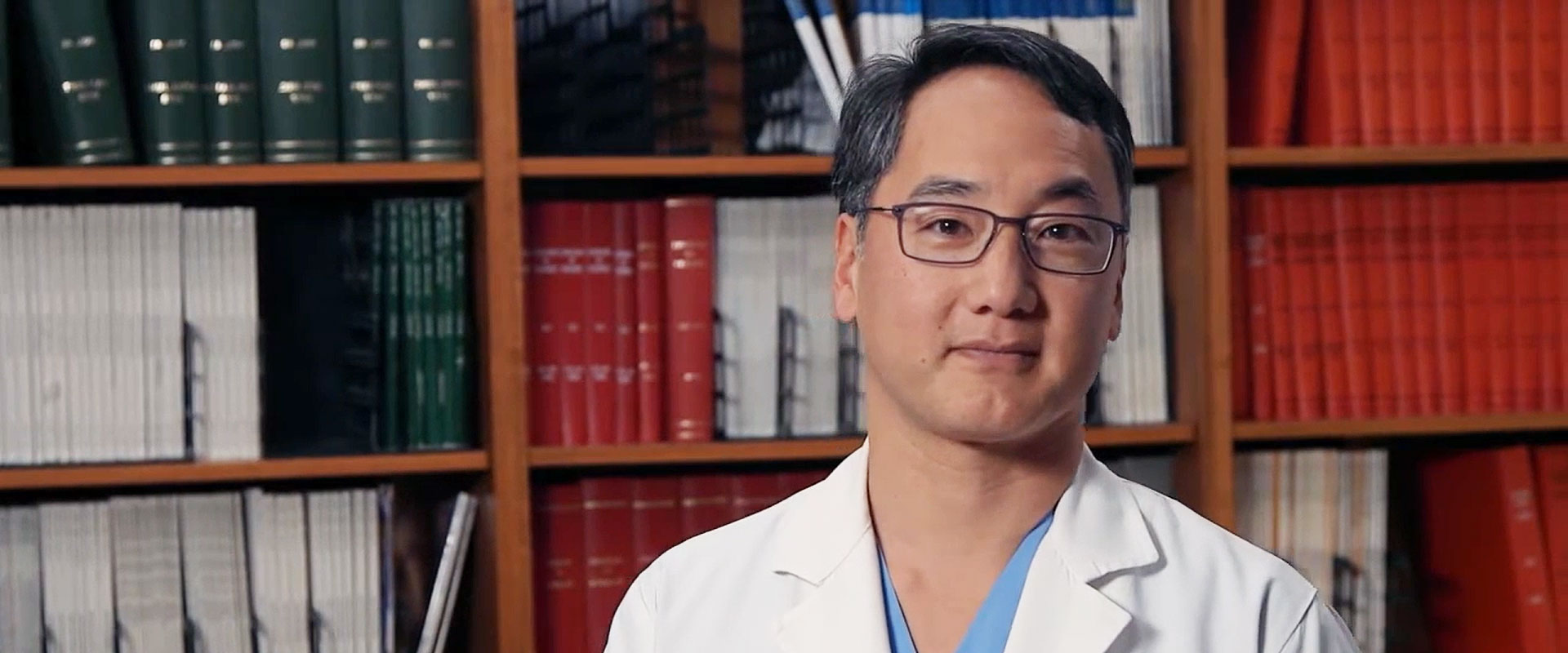
Now, cardiothoracic surgeons like Howard Song, M.D., Ph.D., operate on hundreds of patients a year, enabling the continued lives of so many and building on the innovation and legacy Starr helped introduce. This December, Song was presented with the Dr. Albert Starr Endowed Professorship in Structural Heart Disease, established through the generous support of Edwards Lifesciences Foundation.
“I had always wanted to work on important problems that could really maximize the impact on patient lives,” said Song, head of the Division of Cardiothoracic Surgery in the OHSU School of Medicine. “Heart surgery is one of those fields where it’s usually caused by a dramatic episode in a person’s life and has the potential to permanently address a life-threatening problem for a patient and their family.”
Creating leading-edge techniques
Cardiovascular science has grown leaps and bounds in research and development since its creation. Research in the field is now relatively direct, with new surgical methods and patient outcomes being immediately observable to those working to improve heart surgery.
“The type of research I do is in clinical outcomes and translational research. It’s different than basic science research, where sometimes it is difficult to draw the line between what’s being done on the bench and how you are potentially impacting a patient,” Song said. “With our translational research, we’re doing new in-human implants and devices. In clinical research, we are implementing changes to protocols in the hospital that make recovery from surgery safer. It is quite easy to draw that line, to make the connection between what we’re learning in our research and how we’re advancing treatments for very serious heart problems. It also makes it even more gratifying to be involved in that type of research.”
This research has allowed heart surgery to evolve beyond the classic open-chest procedure many associate it with. Traditional heart surgery is an invasive operation where the patient is put on a heart-lung machine and is exposed to more potential complications. In lieu of open-heart surgery, Song conducts many transcatheter valve replacements, which involve making a needle puncture over the groin where the blood vessels are and accessing the vascular system from that needle hole as a sort of railway to the heart.
“If you’re in New York, you take the N train down to the theater district or wherever you want to go. Here, we’re getting on the train in a patient’s blood vessel through a needle hole, and then taking that train up to their heart, and under X-ray and ultrasound guidance, putting it in exactly the right spot within a patient’s heart to deploy a valve,” Song explained. “The most gratifying thing is when we are seeing the patient the following morning and they say something like, ‘I went for a walk down the hallway this morning, and I could already tell a difference.’ That’s compared to someone having open-heart surgery, who typically doesn’t feel fully recovered for two or three months.”
Song also studies the training of cardiovascular surgeons to understand how young learners process new information. In his field, which is highly physical, learning to do these operations correctly is essential. “One of OHSU’s missions is teaching, attracting young people into our field so that future generations will have outstanding cardiovascular providers to treat them, especially here in Oregon,” Song said.
“We do research in education, trying to learn the best ways to teach something as complex as cardiothoracic surgery. There’s now tracking technology to see which part of the procedure their eyes are drawn to. If you look at someone who’s a master surgeon and you track their vision, it tends to actually be very narrow, because they know the three or four things that are the most important for getting a good outcome. Whereas a learner who’s inexperienced and excited, their eyes tend to be scanning over a very wide portion, and they’re not necessarily focused on the critical part of the anatomy or the step of the operation that a master surgeon is. Tracking that is the type of research done in our division.”
Investing in the future
In the 65 years since Starr’s invention of the first artificial heart valve, OHSU has grown a bustling surgery program filled with experts who develop customized treatment plans for all of their patients.
“Dr. Starr was truly a giant in cardiac surgery,” Song said. “He’s literally one of the founding fathers of cardiac surgery and made possible many of the procedures that are still being done today. He has been a personal hero of mine since I could understand what he achieved. I am deeply honored to be the first recipient of that professorship. It’s also recognition of the progress we’ve made in cardiovascular science recently and how we are investing in the work that continues Dr. Starr’s legacy.”
Reflecting on his time at OHSU, Song remains amazed by the progress his field has made and looks forward to what’s to come.
“I’ve been at OHSU for 21 years now. On a routine basis, we still have wow moments where we go, ‘I can’t believe that this is possible, I can’t believe that this worked, and I can’t believe that the field has moved this far so quickly,’” Song said.
Discovery
Discovery
Discovery